Evidence-based modelling for Africa’s climate, trade and growth.
AICTEM builds integrated analytical tools — multi-region input–output systems, computable general equilibrium models, climate modules and spatial infrastructure models — that turn complex data into decisions for African policymakers.
Four integrated diagnostic programmes
Three integrated diagnostics combine documentary evidence with the CDCGE / SDCGE engines (GTAP database multi-region CGE), a land-use carbon module and the DICE climate model — joined by an Infrastructure programme built on spatial economic and power-sector models and spatial analytics.
Climate
Integrated assessments of each country’s climate position, emissions profile and the economics of adaptation and mitigation to 2050.
View 54 reports →Growth
Identification of the binding constraints to inclusive growth and structural transformation, built on structural input–output diagnostics and the SDCGE structural-dynamic engine.
View 55 reports →Trade
Analysis of trade structure, competitiveness and AfCFTA integration using multi-region input–output accounting and CGE simulation.
View 46 reports →Infrastructure
Integrated diagnostics of transport, power and digital infrastructure, built on spatial economic and power-system models with settlement-level access analytics.
View 52 reports →Continental synthesis reports
Four flagship Africa-wide syntheses draw together AICTEM’s national Climate, Growth, Trade and Infrastructure diagnostics.
Africa Climate Status Report
A continental synthesis of AICTEM’s 54 national Climate Status Reports, rebuilt from the reports’ own certified model results: a single-country recursive-dynamic CGE (CDCGE) coupled to a DICE-type climate module, calibrated on GTAP Africa V3 for 38 economies and on a GTAP–EMERGING hybrid for 16, and run to 2050. By 2050 the median economy loses 12.8% of rural income and 4.5% of food security under unmanaged damage, and the full adaptation ladder compresses those losses to 3.8% and 1.1%. At $50 per tonne the median economy cuts CO2 by 3.5% for a GDP cost of 1.2%, and net public revenue is thin. Two conclusions the series previously published do not survive the current data: the renewable subsidy cuts emissions in 38 economies but raises them in 10, and the country-only carbon price costs less domestic GDP than the uniform price in 41 of 48, so the case for border carbon adjustment cannot rest on modelled leakage. The report groups the continent into seven climate-challenge regions and a composite vulnerability-and-readiness typology, and states plainly what the modelling does not cover: land-use emissions, uncertainty bands and the money cost of adaptation.
Read more →Africa Structural Growth & Transformation Report
A continental synthesis of AICTEM’s 54 national Growth Diagnostics, each pairing a structural input–output diagnostic at 65 sectors with a structural-dynamic CGE (SDCGE) that simulates eight families of growth levers and their 43 distinct component shocks to the early 2040s, on GTAP Africa V3 (38 economies, 2017) and a GTAP–EMERGING hybrid (16 economies, 2018). Services lead value added in 42 of the 54; agro-processing, split out as its own group, exceeds manufacturing in 19. Within each country the manufacturing package delivers the largest output gain in 47 of 54 and agro-processing is the highest-return single lever in 38, but the family that does most for welfare differs from the one that does most for output in 30 economies, and 405 of 2,320 lever outcomes lower measured output while raising welfare, concentrated in trade-cost levers. Scenario magnitudes differ systematically by calibration basis and are never pooled. A percentile classifier assigns each economy to one of four archetypes (16 resource exporters, 15 agrarian, 12 diversifying, 11 services-led) and a basis-neutral structural-transformation index ranks them.
Read more →Africa Trade & Structural Synthesis
A continental synthesis of AICTEM’s 46 national Trade Diagnostics, built on the GTAP Africa V3 input–output cube and the same five model families as the country reports: a fixed-effects gravity model, a corridor and port network model, a calibrated Armington sourcing model, multi-region value-chain analytics and a Caliendo–Parro general-equilibrium model. The 46 economies export about US$594 bn, of which US$71 bn moves between them; against a frictionless benchmark of US$570 bn the average economy realises a fill ratio of 0.14, leaving US$499 bn of intra-African trade unrealised each year. The binding margin is the cost of moving goods, not the tariff schedule: delivered cost averages 18.2% of cargo value while the applied tariff is estimated near zero with a wide interval. The full AfCFTA facilitation package raises modelled intra-African exports by 74.7% at continental level (88% on the mean economy), with non-tariff and standards reform carrying two-thirds of it. Input sourcing is 72.7% domestic, 22.8% from outside Africa and 4.6% from African partners. A composite trade-integration-gap index and typology classify the economies by whether corridors and facilitation, regional sourcing, or bottleneck commodities bind.
Read more →Africa Infrastructure Diagnostic
A continental synthesis of AICTEM’s national Infrastructure Diagnostic reports, combining gridded spatial-equilibrium assessments of road connectivity, city-network models of welfare-maximizing road investment, least-cost power-system models and settlement-level power and digital access analytics. It draws together where Africa’s transport, power and digital gaps bind, and shows that the highest returns arise where these gaps coincide in space — making the case for spatially coordinated, bundled infrastructure investment.
Read more →Explore the continent
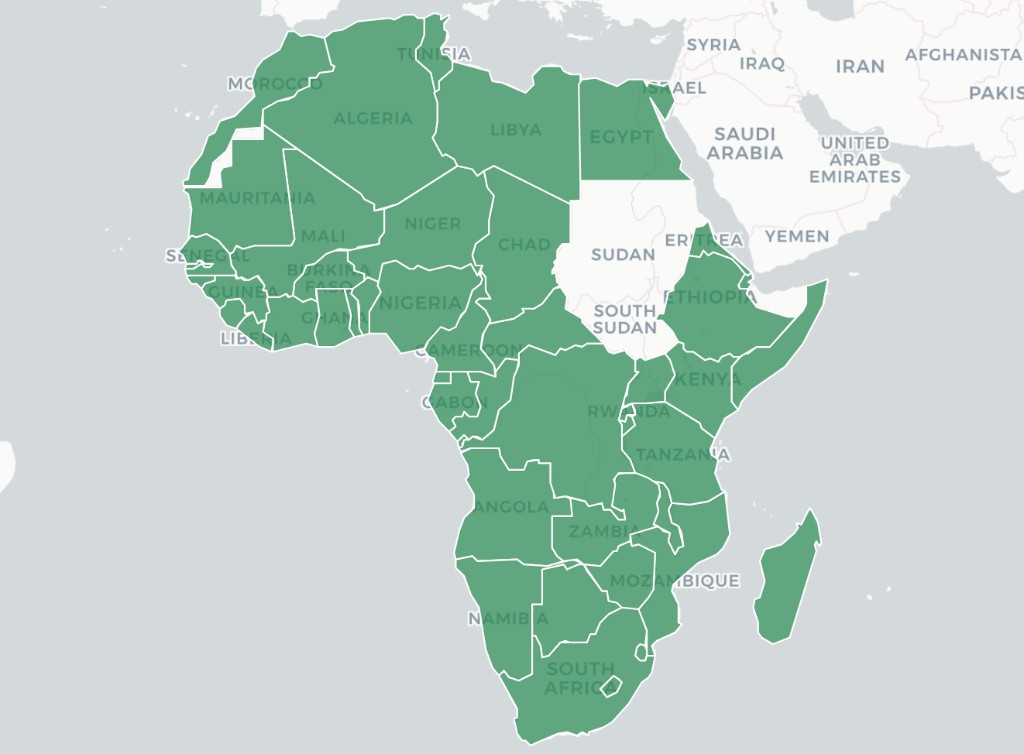
Four thematic maps show where Climate, Growth, Trade and Infrastructure reports have been implemented across Africa — click any country to open its reports.
Open the coverage maps Download by country